h1-bg

Premium WordPress theme for construction companies, contractors, builders, and a variety of other construction-related businesses.

  • 28238 Kelsie Lane Apt. 451,

    Port Annabelport

  • 8.00am - 10.00pm

    (Sat - Thursday)

  • Indsrop@gmail.com

    (10am - 05 pm)

Key Uses of CCR Copper Rods in Wire and Cable Production

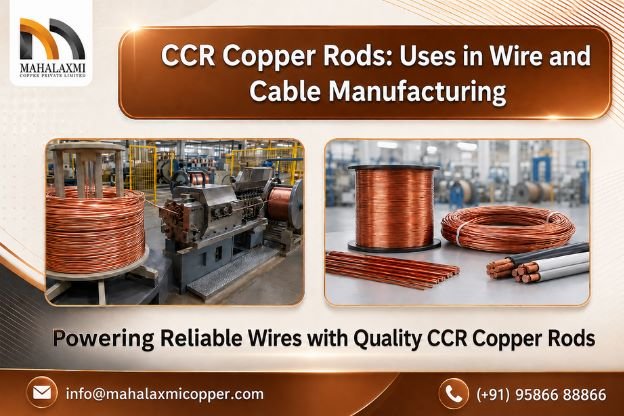
CCR Copper Rods Uses in Wire and Cable Manufacturing
For wire and cable producers, raw-material consistency affects every stage of production. Among the most important CCR Copper Rod Uses is its role as feedstock for drawing conductive wires in precise diameters. From building wires to power cables and automotive harnesses, a reliable rod supports steady processing and dependable output.

What Is a CCR Copper Rod?

CCR stands for Continuous Cast Rod. Manufacturers melt copper, cast it continuously and roll it to the required diameter on an integrated line. This process produces long coils with consistent dimensions and surface quality.
The 8mm CCR Copper Rod is widely used for electrical wire production. Manufacturers often select ETP Copper Rod for its conductivity and drawability. However, the copper grade must match the final cable specification and processing conditions.

How CCR Copper Rod Becomes Electrical Wire

Wire Drawing

First, a drawing unit feeds the rod through progressively smaller dies. Each die reduces its diameter without removing material. Therefore, uniform dimensions, controlled hardness and a clean surface support stable drawing speeds.
Depending on the product, the manufacturer draws coarse, intermediate or fine wire. For example, a CCR Copper Rod for Wire Manufacturing may become a solid building-wire conductor or fine strands for a flexible cable.

Annealing, Stranding and Insulation

Drawing work-hardens copper, so manufacturers anneal wire when greater flexibility is required. They may then bunch or strand several wires. Finally, the conductor moves to insulation and testing lines. As a result, rod quality influences both processing efficiency and final performance.

Major CCR Copper Rod Uses in Wire and Cable Plants

Building Wires and Flexible Cables
Building-wire manufacturers use drawn copper conductors in residential, commercial and industrial circuits. Moreover, fine strands provide the flexibility needed in appliance cords, control cables and portable equipment leads.
Power and Industrial Cables
A Copper Rod for Cable Manufacturing becomes conductors for low-, medium- and application-specific power cables. Consistent conductivity limits avoidable losses, while dependable mechanical properties support drawing and stranding.
Winding and Magnet Wires
Transformer, motor and generator manufacturers need consistent winding conductors. Therefore, producers draw copper rod into fine round or shaped wire before applying enamel. A clean surface matters because defects may affect coating continuity.

Automotive and Telecommunication Cables

Modern vehicles need wiring for power, sensors, lighting and controls. Consequently, manufacturers draw fine strands for harnesses and battery cables. Similarly, copper conductors serve selected telecommunication, data and signal applications.

Why Rod Quality Matters During Wire Drawing

The best Continuous Cast Copper Rod supports stable production rather than merely meeting a diameter requirement. A uniform rod can offer:
  • Consistent electrical conductivity across batches
  • Smooth drawability with fewer wire breaks
  • Better dimensional control in finished conductors
  • Cleaner surfaces for insulation or enamel coating
  • Reduced die wear, scrap and unplanned downtime
However, these benefits depend on the rod specification, handling and compatibility with the drawing line. Buyers should evaluate actual test data instead of choosing only by price.
Quality Checks and Smart Buying Tips
Before purchasing Copper Rod for Wire Drawing, confirm the grade, diameter, tolerance, coil weight and packing. In addition, review conductivity, tensile strength, elongation and surface condition. State every applicable standard clearly in the purchase specification.
Surface oxide, dents, laps, inclusions or irregular coils can cause breaks and poor finishes. Therefore, request batch traceability and inspection documents. Store coils in a clean, dry area and prevent rough handling.
A common mistake is assuming that every copper rod suits every conductor. ETP and oxygen-free grades, for instance, serve different processing and end-use requirements. Likewise, the lowest-cost rod may increase total production cost if it causes slower drawing speeds, excess scrap or repeated stoppages.
Choosing a Reliable CCR Copper Rod Supplier
A dependable supplier should understand the buyer’s final wire size, drawing process, intended cable application and quality expectations. Furthermore, consistent supply, responsive technical communication and documented inspection help manufacturers plan production with greater confidence.
Mahalaxmi Copper supplies copper products for industrial requirements from Ahmedabad, Gujarat. By discussing grade, diameter, coil and testing needs before ordering, wire and cable manufacturers can select material that fits their production process instead of relying on a one-size-fits-all specification.

Conclusion

The main CCR Copper Rod Uses extend across building wires, power cables, flexible conductors, winding wires and automotive harnesses. However, successful performance begins with the right grade and verified quality. When manufacturers match rod properties to their drawing line and final conductor standard, they can improve productivity, reduce waste and produce more reliable electrical products.

FAQs

1. What are the main CCR Copper Rod Uses?
CCR copper rods mainly serve as feedstock for drawing electrical conductors. Manufacturers convert them into building wires, flexible cable strands, power cable conductors, winding wires, automotive harness wires and selected communication conductors.
An 8mm CCR Copper Rod provides a practical starting diameter for many drawing lines. Manufacturers can reduce it through multiple dies to produce different wire sizes efficiently. However, they must also check diameter tolerance, conductivity, surface quality, tensile properties and coil compatibility before approving the rod for regular production.
ETP copper contains a controlled amount of oxygen and is widely used for general electrical conductors because of its high conductivity and good drawability. Oxygen-free copper has very low oxygen content and suits applications that demand special forming, joining or environmental performance.
Important checks include electrical conductivity, diameter and ovality, tensile strength, elongation, surface condition and chemical composition. Depending on the application, buyers may also review twist performance, surface oxide and additional customer-specific tests.
Consistent rod can reduce wire breaks, drawing stoppages, die wear and scrap. Moreover, reliable dimensions and surface quality help manufacturers maintain production speed and conductor uniformity.
Mahalaxmi Copper Products LTD Logo

A wonderful serenity has taken possession of our entire soul, as we craft copper products that embody elegance and purity. From the moment you touch our copper, you'll feel a sense of calm and sophistication.

Copyright © 2024 mahalaxmi copper | Made by uvdigitalsolution