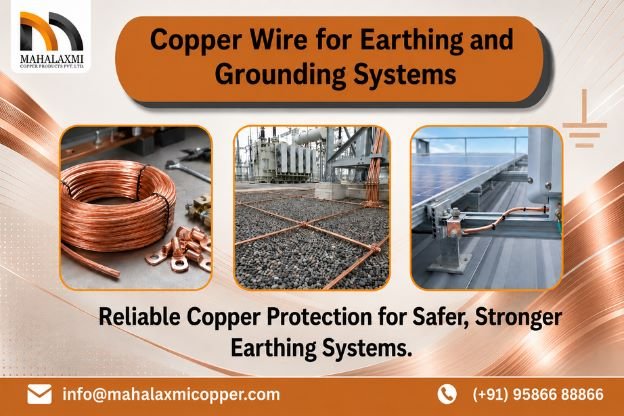
Moreover, copper is easy to form, terminate, and connect with suitable lugs or approved joining methods. This helps contractors create reliable bonds in panels, machines, earth pits, and grounding grids. However, quality wire alone cannot correct undersized conductors, loose joints, or a poorly designed electrode system.
Copper Wire for Electrical Earthing connects exposed metal parts, distribution boards, cable trays, and enclosures to the earthing network. Similarly, Copper Wire for Equipment Grounding is used with motors, generators, pumps, control panels, and machinery. During an insulation fault, the conductor helps create a controlled, low-impedance route for fault current so protective devices can respond.
Factories use Copper Wire for Industrial Earthing to bond machinery, structures, panels, and utility systems. In addition, Copper Wire for Grounding Grid may form part of a buried network around a plant or switchyard.
The conductor size and grid layout should consider the fault level, clearing time, soil conditions, touch and step voltage risks, and the project’s approved electrical standard.
Copper Wire for Substation Earthing supports the bonding of equipment, structures, neutral points, fences, and the main earth grid. Likewise, Copper Wire for Transformer Earthing may serve transformer bodies, neutral connections, and related equipment.
IEC 60364-5-54 covers earthing arrangements and protective conductors for low-voltage installations. However, substations must also follow applicable utility requirements and project-specific engineering standards.
Solar projects use Copper Wire for Solar Earthing for module structures, inverters, AC and DC panels, and metallic equipment. Meanwhile, telecom sites and data centers need dependable bonding for sensitive electrical and electronic systems.
Copper Wire for Earthing Pit commonly connects the main earth bar or electrical equipment to an earthing electrode. Similarly, Copper Wire for Earth Electrode must maintain a secure connection at the termination point. Copper Wire for Earthing Pit commonly connects the main earth bar or electrical equipment to an earthing electrode. Similarly, Copper Wire for Earth Electrode must maintain a secure connection at the termination point.
Therefore, installers should clean contact surfaces, use compatible connectors, protect exposed joints where required, and prevent sharp bends or mechanical damage.
In aggressive soil, material compatibility needs extra attention. For example, buried dissimilar metals can create galvanic corrosion. Consequently, the designer should review the electrode material, conductor, connectors, soil conditions, and protective measures before installation.
First, determine the conductor cross-section from the prospective fault current, fault duration, protective-device operating time, installation method, and applicable standard. Never choose an earthing wire only by price or by copying another project.
Second, confirm whether the specification requires bare, insulated, solid, or stranded copper wire. Stranded wire usually offers easier routing, while bare wire may suit specified grids and bonding arrangements. However, the approved electrical drawing must control the final selection.
Third, check conductor dimensions, copper quality, weight, surface condition, and electrical continuity. The supplier’s quotation should clearly state the size, construction, supply length, packing, and testing requirements.
Common mistakes include using undersized wire, leaving loose or painted contact surfaces, mixing incompatible metals, creating unprotected joints, and placing conductors where they may be crushed or cut.
Furthermore, the earth should not be treated as the only effective fault-current return path. Continuous bonding and a low-impedance metallic path remain essential for the correct operation of protective devices.
Finally, test the completed system during commissioning and inspect it periodically. Check accessible joints, corrosion, heating, mechanical damage, and recorded earth-resistance values. After major electrical modifications, review and test the earthing network again.